The Meeting Went Great. Why Is There Still No Program? (Part 1 of 6)
Part 1 of 6 | Lessons from GMA's Building a Defense Industrial Powerhouse playbook
A defense-tech startup closes a strong Series B. The demo works. The Program Manager asks for a follow-up. The founder walks out sure the contract is coming.
Eighteen months later, the company has three SBIRs, a DIU prototype, a wall of unit logos, and no Program of Record. The runway is gone.
The technology didn't fail. The adoption strategy did. Past Series B/C, that's how most defense startups die.
At Grant Management Associates, we've written a 100-page founder's playbook on closing that gap, from Year One to an enduring defense business. This series walks through it one stage at a time, starting where most founders go wrong.
Year One Mistake #1: Pitching the PM like an investor
Investors want breakthrough performance and a big market. A PM wants to know four things: will it work in the field, can it plug into what we already have, will it hold my schedule, and will this company still exist in two years?
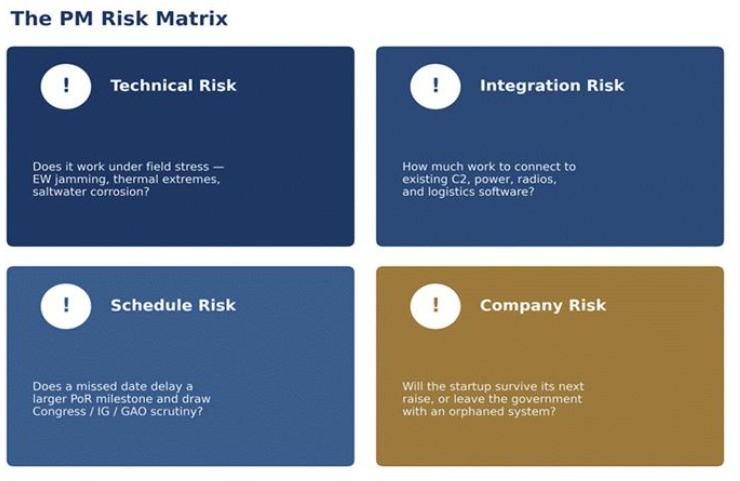
Each category needs its own kind of evidence. Technical risk needs test data. Company risk needs a cap table and a runway number. A great answer to one won't cover another.
Year One Mistake #2: Starting at the top
A retired four-star intro feels like a shortcut. It rarely is.
Programs get funded when champions carry a capability up through five levels: operators who feel the gap, evaluators who validate it, PMs who own the budget, PEOs who move money, and senior leaders who set direction. Skip a level and the campaign stalls.
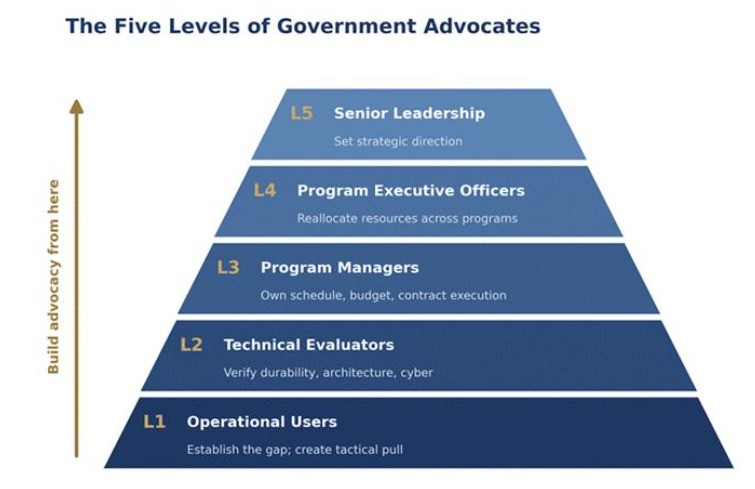
Senior engagement can speed up an effort that already has evidence behind it. It can't replace operator pull or lab validation.
What it looks like in practice
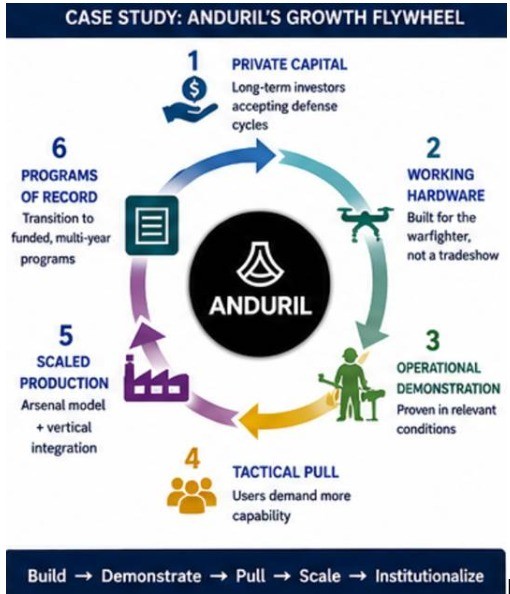
Anduril didn't wait for a formal requirement. It built working systems with private capital, put them in front of operators and evaluators, and created demand that PMs had to answer. The large manufacturing investment came after that demand, not before.
Shield AI proved its autonomy software on its own aircraft. Then it separated the software so it could run on other companies' platforms, including an F-16 variant under DARPA's ACE program. That gave Shield AI two revenue paths instead of one.
The "Perpetual Pilot" trap is the opposite pattern. A startup stacks up SBIRs and prototypes, treats each one as a sale, and never ties any of them to a budget line. When the prototype money ends, so does the company.
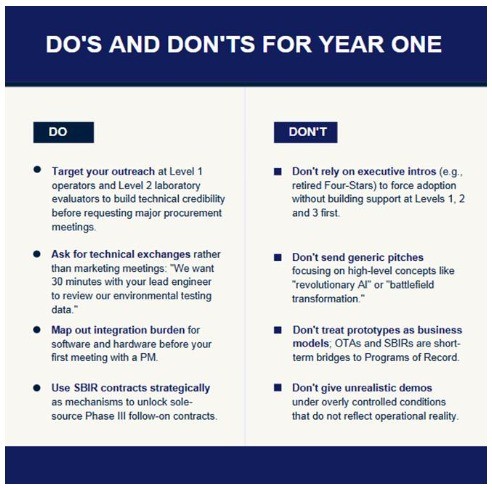
Year One Mistake #3: Spending on visibility instead of risk
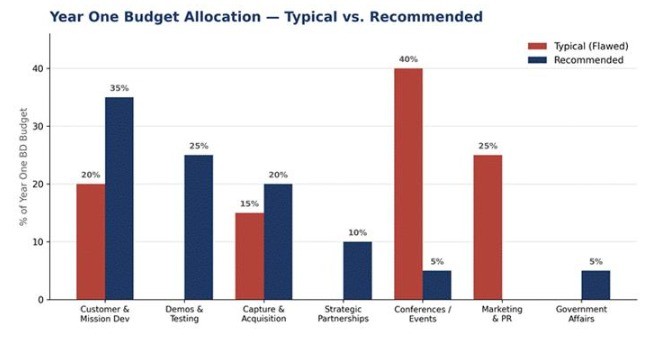
The typical Year One budget puts 65% into conferences, marketing, and PR. The recommended budget moves that money into mission development, testing, capture, and partnerships. Booth traffic does nothing to answer the PM's risk questions. Test data does.
Year One Mistake #4: Leading with TRL alone
Technology Readiness Level gets you through the solicitation filter. It doesn't get you funded.
A TRL 6 system with no manufacturing plan, no integration story, and no PM sponsor is no more fundable than a TRL 4 system that has all three. PMs now check TRL against Manufacturing Readiness (MRL) and Integration Readiness (IRL). If you can't speak to both, the number on your slide won't matter.
A free resource worth knowing about: APEX Accelerators (apexaccelerators.us) offer free SBIR and contracting counseling through 90+ regional offices. Start there before you pay anyone.
Where GMA comes in:
GMA has secured more than $2.5B in federal funding since 2009. Our Defense & Technology team pairs senior defense and veteran operational experience with deep SBIR/STTR and commercialization expertise, including Sonia Vohnout's 30+ years. We help founders turn awards into a path to a Program of Record, not just one more logo.
Want the tools behind this article?
Comment "CAPTURE" below and I'll send you two of the templates we use with clients:
✅ Our PM cold-outreach email template, the 5-part structure built to land technical exchanges
✅ The 90-Day Capture Plan, a one-page tracker that tells you which pursuits to keep and which to drop
Follow me for Part 2: Year Two: Turning a pilot into a Program Element.