Part 2: Year Two — Converting Relationships Into Programs
For enduring program funding, PPBE/POM alignment is usually central—but bridge funding, reprogramming, production OTs and Phase III awards can sometimes help.
Crossing the Valley of Death
The defense startup's hardest transition often comes after a successful prototype. The “Valley of Death” is the roughly 18–36 month gap between prototype funding—through SBIR, OTA or internal R&D—and a dedicated, multi-year Program of Record budget line.
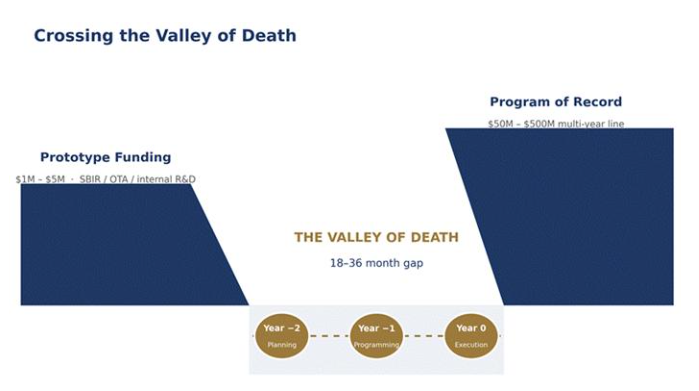
The gap is not simply a funding problem. It is a timing problem: the government's budget cycle moves well before the fiscal year in which money is executed.
PPBE—Planning, Programming, Budgeting and Execution—means the capture campaign has to begin before the company needs the money.
A PM conversation about Year-0 money is often already too late. The funding conversation may need to start roughly two years earlier.
What This Means for Founders
Run Three Campaigns at Once
Winning inside the Pentagon is necessary, but it may not be sufficient. The strongest defense companies operate three connected campaigns: the Warfighter campaign, the Pentagon acquisition campaign, and the Capitol Hill campaign.
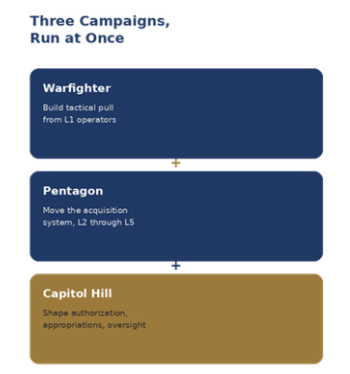
Congress is not a procurement office. A Member cannot simply direct a Program Executive Officer to buy a company's system. Congress shapes authorization, appropriations, oversight, policy, industrial-base priorities and long-term national-security direction.
The Right Congressional Question
What congressional action, if any, would remove an institutional barrier to adoption or reinforce an existing national-security priority?
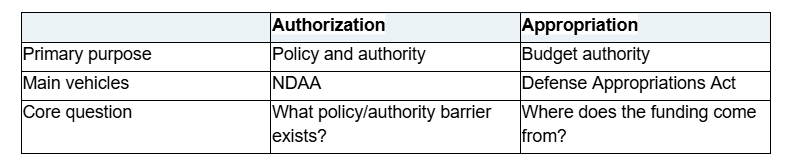
Authorization vs. Appropriations
Map the Congressional Ecosystem
The objective is not to “go around” the Department of War by going to Congress. It is to build a coherent institutional case in which operational demand, acquisition sponsorship, budget alignment and congressional awareness reinforce one another.
Congressional Engagement Is Part of Capture
The RFP is late in the process. Congressional engagement belongs inside the capture cycle, not after it. The most effective companies educate staff, exchange evidence, understand the government context, align to legitimate policy or funding opportunities, and maintain an institutional relationship over time.
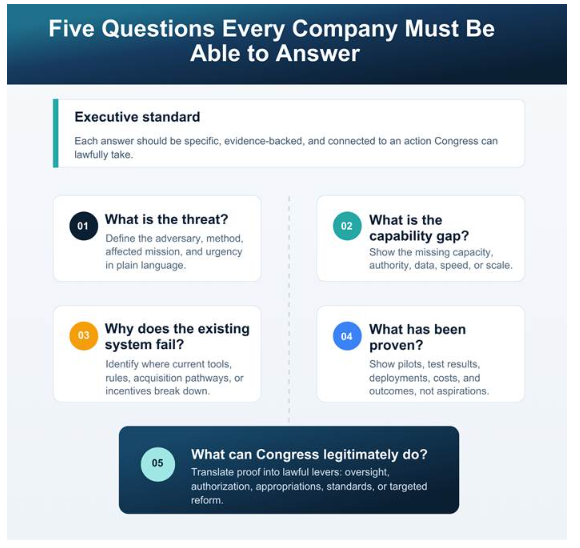
Build the Narrative Around the Mission
A congressional office is not in the business of funding startups. It is trying to solve capability gaps, protect the industrial base, serve constituents and advance national-security priorities.
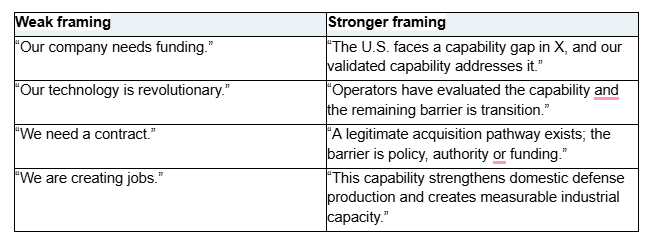
Synchronize the Pentagon and Capitol Hill
From Relationships to Scaled Adoption
Year Two is about converting validated relationships into an acquisition pathway that can survive beyond a pilot. The company needs a contracting strategy, a credible demonstration, production readiness and a clear transition route.
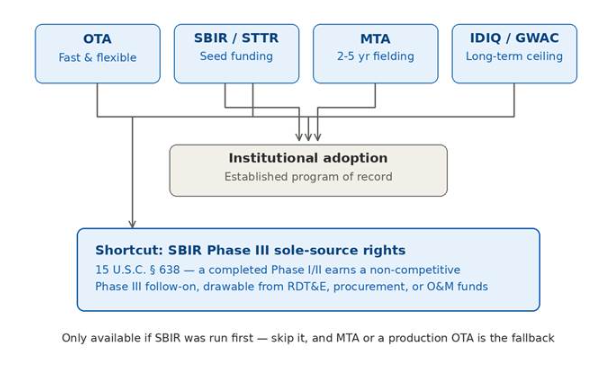
Choose the Pathway Strategically
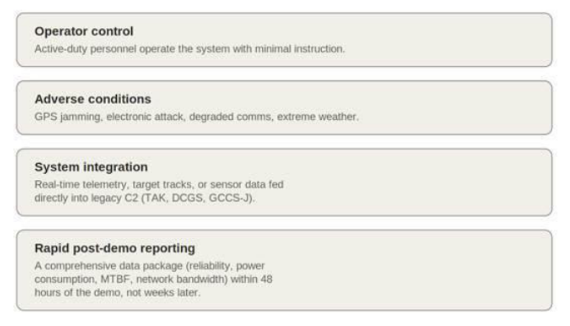
Design Demonstrations to Retire Risk
A high-impact demonstration does more than show what the technology can do. It puts the system into conditions that matter to the customer: stressed operational environments, military operators, real C2 integration and repeatable performance.
What the Year-Two Lessons Show
How GMA Helps — Part 2: Year Two
GMA tracks defense funding priorities, policy shifts and the PPBE calendar so demonstrations and capture activity are timed to real budget decisions—not simply to the company's preferred schedule. GMA also helps evaluate pathways such as SBIR Phase III, OTA, MTA and IDIQ, and supports the documentation and commercialization strategy required to move from prototype toward adoption.