
Part 3: Year Three — Becoming a Major Defense Supplier
“In defense procurement, manufacturing capability is part of the core product, not a downstream operational detail.”
3.1 Scaling for Industrial Advantage
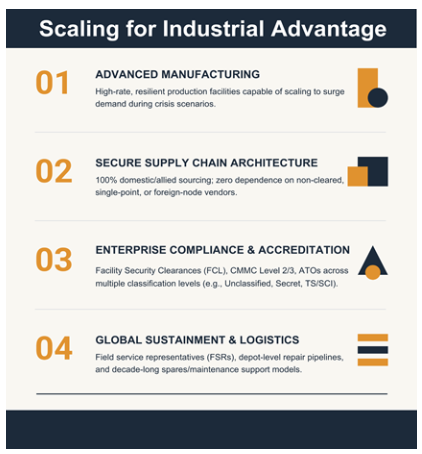
By Year Three, the evaluation shifts to industrial scale, production throughput, supply chain security, and long-term sustainment:
• Advanced manufacturing high-rate, resilient production facilities capable of scaling to surge demand during crisis scenarios.
• Secure supply chain architecture — map statutory, regulatory, program-specific, security, and supply-chain requirements at the component level; sourcing restrictions vary by system, component, funding, country of origin, and contract clause, and should be confirmed against the specific program rather than assumed.
Exhibit 55: Surge-Capable Production Line

• Enterprise compliance & accreditation — Facility Security Clearances, CMMC Level 2/3, ATOs across multiple classification levels (Unclassified through TS/SCI).
• Global sustainment & logistics — Field Service Representatives, depot-level repair pipelines, decade-long spares/maintenance support models.
Exhibit 56: Scaling for Industrial Advantage
3.2 Manufacturing as a Competitive Advantage
Exhibit 57: U.S. Aerospace Manufacturing Line

In defense procurement, manufacturing capability is part of the core product, not a downstream operational detail.
Exhibit 58: Evolution of Manufacturing
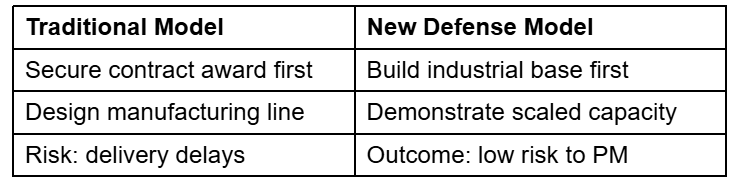
Manufacturing scaling framework:
● Design for Manufacturability (DFM) — standardize sub-assemblies, minimize custom fasteners, use COTS components wherever possible.
● Capital investment ahead of the contract — automated tooling, environmental test chambers, and production infrastructure funded before the major award, not after.
● Surge capacity testing — demonstrate to PEOs an actual, executed 3–5x production expansion within 90 days, not a modeled one. A PM sizing a wartime reserve requirement is going to ask for evidence.
3.3 The Back-Office Compliance Regimes That Blindside Scaling Companies
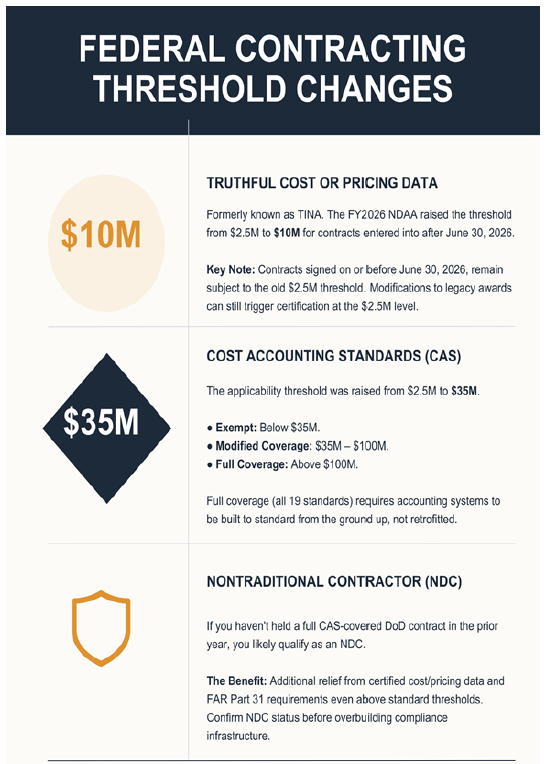
FCL, CMMC, and ATOs get the attention because they gate whether you can touch classified or sensitive systems at all. Two other regimes get far less attention but reliably surprise Year 2–3 companies once contract size crosses certain thresholds — and both changed materially as of mid-2026:
Exhibit 59: CMMC 2.0 Certification Levels
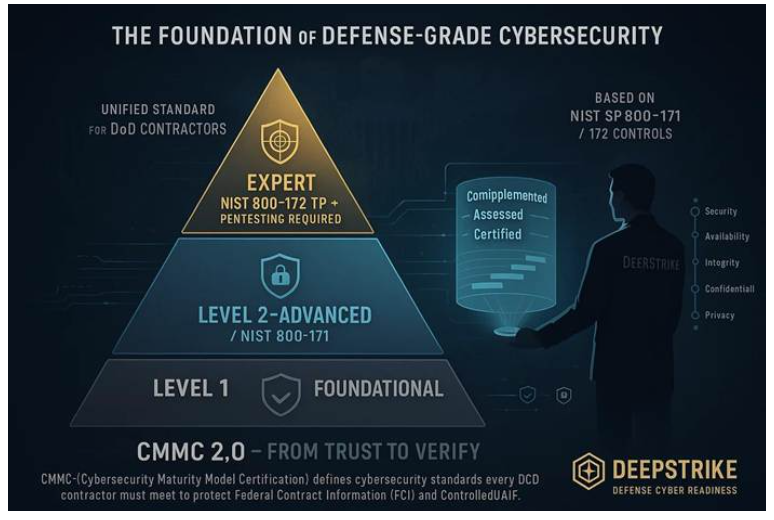
Note: CMMC implementation status has continued to evolve; as of this writing, Phase 1 implementation is paused while core safeguarding obligations under NIST SP 800-171 and DFARS remain in force. Confirm current CMMC policy status and the specific clause set in the target solicitation before treating any level as a settled gate.
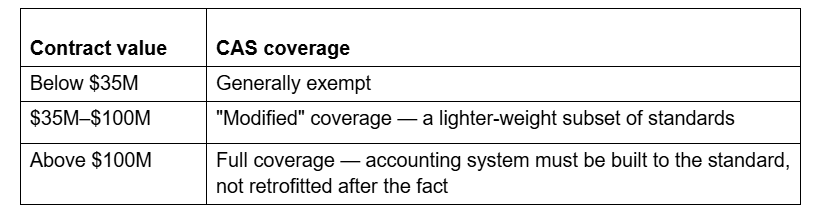
Exhibit 60: CAS Applicability Thresholds
Nontraditional defense contractor (NDC) exemption. If you haven't held a full CAS-covered DoW contract or subcontract in the prior year, you likely qualify as an NDC — which, under the same NDAA, gets you additional relief from certified cost/pricing data and FAR Part 31 cost-principle requirements, even above the standard thresholds. Confirm NDC status with your contracts team before assuming you need full compliance infrastructure; overbuilding compliance you don't yet need is a common and avoidable Year 2 cost.
Exhibit 61: CAS and Certified Cost/Pricing Data Thresholds
3.4 Congressional Engagement & Policy Alignment
Exhibit 62: Engagement & Policy Alignment
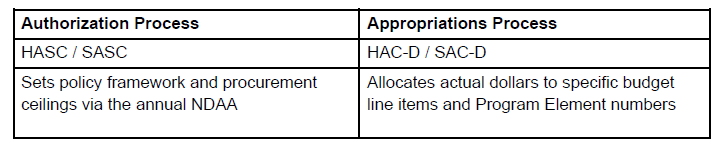
● Protect Program Elements — monitor annual subcommittee markups to ensure your target PE line items survive.
● NDAA legislative provisions — coordinate with staffers to draft language directing the Services to evaluate or field capabilities in your domain.
● Local economic impact — highlight your facility's regional footprint, supply chain partners, and engineering headcount during legislative briefings; a jobs-and-supply-chain narrative resonates with appropriators in a way a pure capability narrative doesn't.
3.5 Case Studies
Exhibit 63: Palantir: The DCGS-A2 Protest

Palantir Technologies: The same case, viewed as a supply-side lesson. The DCGS-A2 protest (detailed in Part 2) also demonstrates a Year Three point: existing procurement statutes offer real, enforceable protections for commercial technology companies once you're large enough to litigate for them. That's a scaled-company move, not a Year One move — but it's worth knowing the tool exists.
Illustrative pattern the single-source supply chain failure. A recurring pattern among hardware-heavy startups: a company secures a major production contract while its engineering team still relies on specialized, non-cleared foreign vendors for components like optical lenses or PCBs. An audit during performance discovers the components breach NDAA supply chain restrictions. The result is a government-issued stop-work order, frozen payments, and months of schedule slip while the company redesigns the hardware and requalifies domestic suppliers.
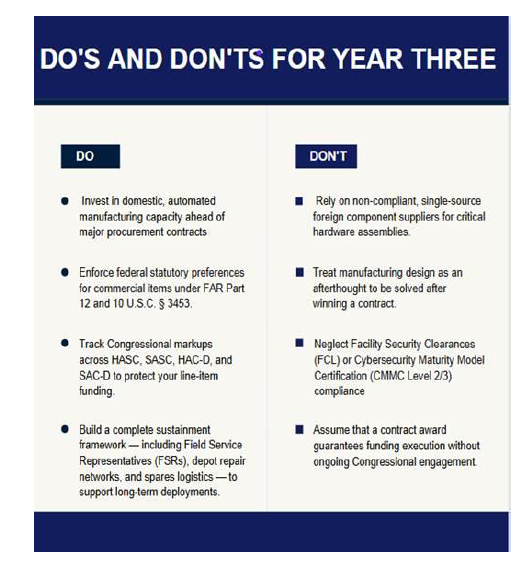
Lesson: NDAA-compliant, domestic/allied supply chains have to be built during the design phase, not qualified after a production contract is already signed — replacing non-compliant components late in the process is far more expensive than designing around them from the start.
Exhibit 64: Year 3 Do’s and Don’ts
How GMA Helps Part 3: Year Three
Scaling into a major supplier means the compliance regimes in 3.3 stop being theoretical CMMC readiness, CUI protocols, and NDAA-driven thresholds all become live risk. GMA supports opportunity intelligence, capture planning, funding-pathway analysis, proposal development, and strategic messaging around this compliance picture, and coordinates with qualified cybersecurity assessors, accounting/cost specialists, and export-control counsel where a client's needs require specialized, licensed, or credentialed advice — reducing the risk of disqualification on non-technical grounds at the exact stage where a mistake is most expensive.
At this stage, some companies also start encountering classified and sensitive-program requirements — GMA helps clients understand eligibility and onboarding pathways for initiatives like the DoW Special Access Program Corporate Portfolio and DARPA's BRIDGES program, and acts as a secure liaison between commercial teams and government sponsors so engagements stay within approved export-control and information-security boundaries from the outset